Live match statistics
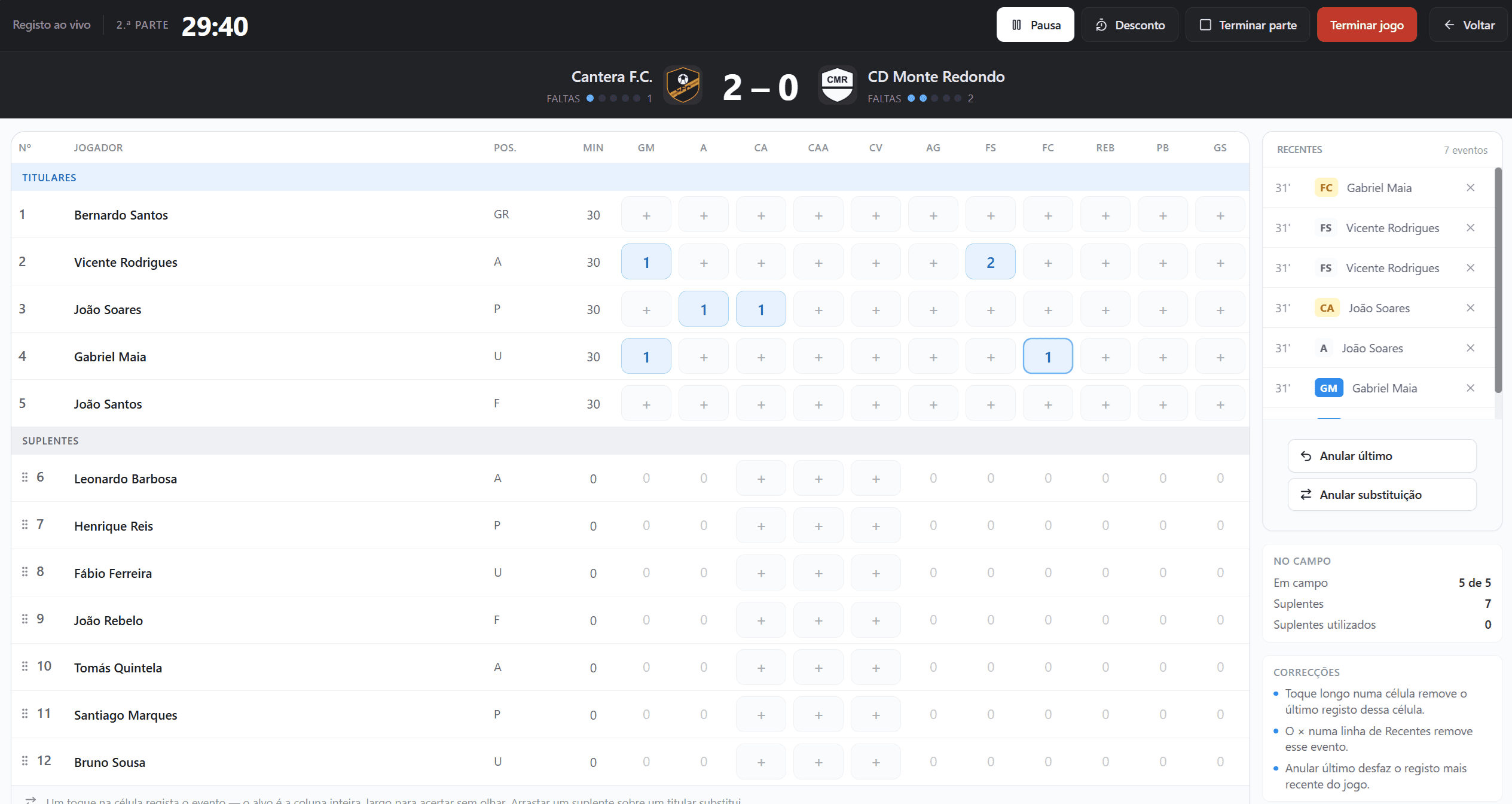
A tablet courtside, the squad grid on screen and events logged by tapping while the match runs. At the final whistle you have the result, every athlete's minutes, plus/minus and a printable report — with nobody having to write up a sheet of paper afterwards.
Recording the match after the match records half of it
Writing the match on paper captures the goals and the cards. It loses each athlete's minutes, it loses who was on court when you conceded, and it loses the team foul count that decides the fifth minute of each half. By Monday, back home, nobody remembers exactly — and what survives is a reasonable version of the match rather than the match.
From kick-off to the season report
The same recording feeds the match, the team's season and the statistics for the whole club.
Clock and tap-to-log events
The clock is rebuilt from timestamps, so a phone that locks does not lose the match. Events can only be attributed to whoever is on court, and that is derived rather than typed.
Substitutions and minutes
Substitutions by dragging in the squad table. Each athlete's minutes come from that, including anyone sent off, and are written to the match sheet at the end.
Team fouls
Fouls committed and suffered counted per team, with a warning on the fifth — which in futsal is the one that changes the game.
Post-match report
Minutes, goals, cards, plus/minus per athlete and the match timeline, printable. Plus/minus counts goals with that athlete on court, which is the reading a paper match sheet never gives you.
Season statistics
A squad leaderboard, match-by-match progression and a printable head-to-head between two athletes, with the eligibility threshold derived from the team's own configuration.
Club statistics
Every age group in a season on one screen, by team and by athlete, with recording coverage shown so you never compare a well-recorded age group against a poorly recorded one.
Numbers that survive an argument
A club statistic is only worth having if nobody can take it apart in two minutes. The decisions below are what separate a number from a number you can rely on.
Events replay in order, not by minute
A goal and a substitution often share a minute. Replaying the match in recorded order is what makes plus/minus come out the same every time.
Who is on court is derived
It is not the starter flag: it is the result of the substitutions and dismissals up to that instant. Live recording and the report use the same calculation, and a test fails if the two ever disagree.
Coverage is always shown
Matches without substitutions or without a starting line-up are left out of the totals — and reported. A quietly incomplete average is worse than no average.
The threshold belongs to the team
Full-match minutes are a team setting. Under-11s and seniors do not share a denominator, or the comparison would mean nothing.
Questions about live match statistics
Recording happens in the browser, with the app installed on a tablet or phone. A patchy connection is tolerated because the clock is rebuilt from timestamps rather than counting on its own, but the recording is saved on the server — it is not a tool designed to work offline for hours.
Whoever the club authorises. Permissions are per group and can be limited to each person's own teams, which is the usual arrangement: each age group's team manager records that age group's matches.
Events can be corrected. The recording order is preserved even after deleting an event, which avoids the classic problem of two rows ending up in the same position.
It does. The match sheet can be filled in afterwards, with a starting line-up and events. What you lose is what only exists live — exact minutes and fouls per half — and the report flags that gap rather than hiding it.
Training attendance appears in the athlete's summary and in the club overview, alongside the match numbers. They are separate counts shown together, which is how a coach looks at them.
Carry on from here
Record the next match as it happens
Take the tablet to the hall and leave with the report already written.