Club financial management software
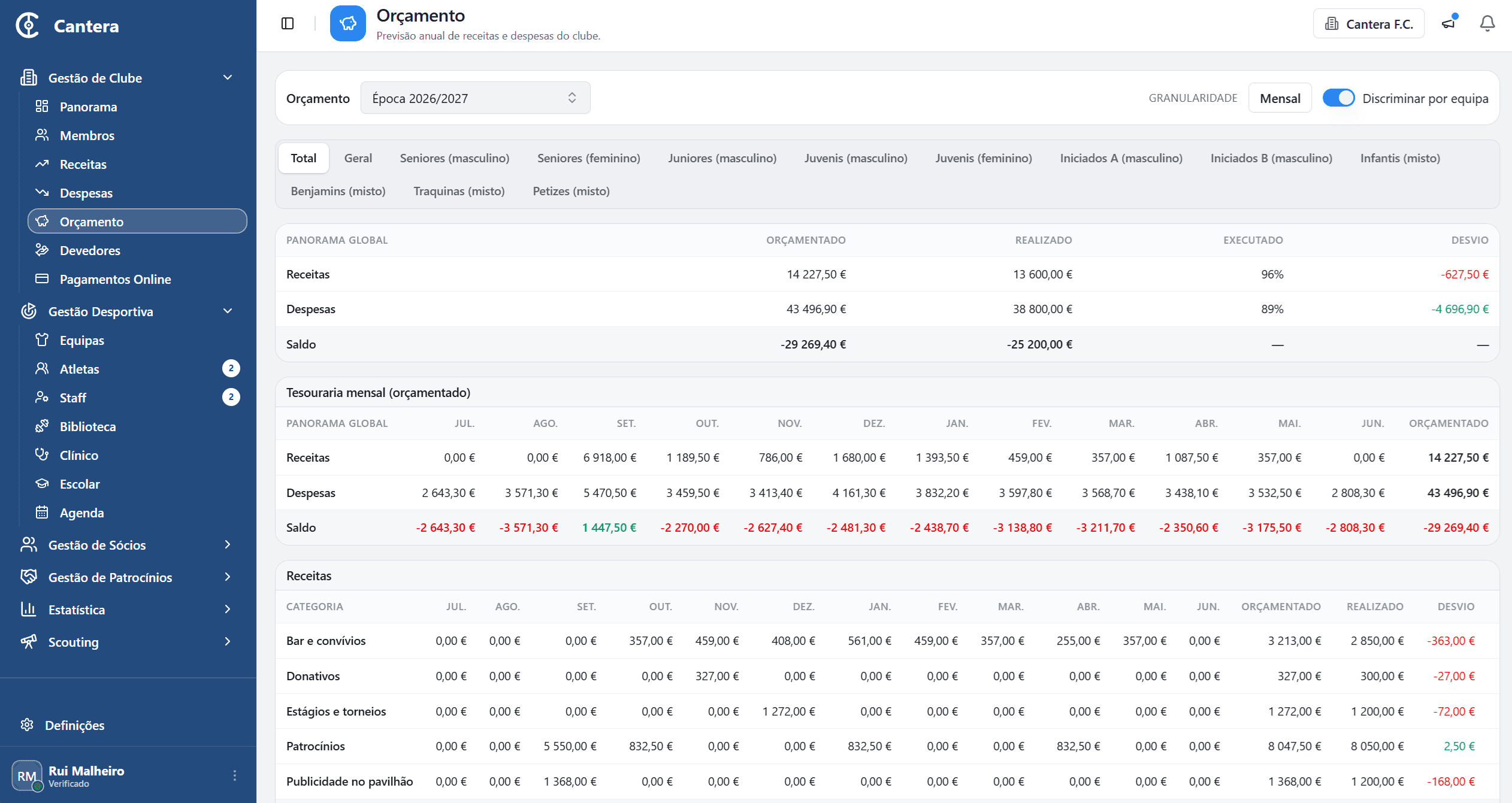
Monthly fees raised in series, statements per athlete and per member, numbered documents, expenses and income logged with their attachments, and an annual budget where the actuals come from the movements instead of being typed in again. The club's books in one place, and agreeing with each other.
The club's accounts should not depend on one person
In many clubs there is one person who knows the accounts — and a file on their computer. While they are there, it works. When they leave, the club discovers it does not know how much is outstanding, which fees were waived and why, or how much went on referees last year. The problem is not the spreadsheet: it is that the spreadsheet is the only copy of the truth.
From the monthly fee to the season's budget
Collection, spending and forecast joined by the same categories, so actuals never need entering by hand.
Statements
Every athlete and every member has a statement, with the items raised, the status of each and the full history. It is where you answer the question people ask most: is this family up to date?
Monthly fees in series
Raise a whole season for an age group in one idempotent operation. Notices can then be issued automatically each month, with reminders before and after the due date.
Payment notices and receipts
Documents numbered within a series, with a public page and QR code. Voiding a notice frees its entries to be reissued; once a receipt exists it can no longer be voided, and that is what keeps the totals consistent.
Expenses and income
Expenses and one-off income logged with supplier, category, department, optional VAT and the document attached. Terms and overdue status are derived from the date, not ticked by hand.
Annual budget
A forecast by category and by team-season, annual or month by month. Actuals are derived from the movements and compared line by line, with monthly cash flow alongside.
Online payment
The document's public page accepts card or instant transfer. Settlement is reconciled by webhook and the receipt follows from that, not from someone marking it paid.
The rules that make the numbers close
A finance module is judged on the hard cases, not the easy ones. These are the rules that stop two screens in the same club showing two different debts.
Debt is what has already been demanded
An unpaid entry only counts as debt once a notice has been issued. Before that it is a forecast, even if the expected date has passed — and it is the same rule on the statement, on the debtors list and in the overview.
Every date has an owner
The item has an accrual date and an expected due date; the document has an issue date and the due date that counts; a standalone movement has its operational date. Mixing them is where most reports that fail to reconcile come from.
Actuals are never typed
They come from the season's movements, grouped by category and by team. There is no second place to update, and therefore no second place to forget.
A date is worth the whole day
A due date of 31 March does not fall overdue at one minute past midnight: it falls overdue the next day. It reads like a detail until an entire club gets reminder emails in the small hours.
Questions about club financial management
They can be. Fees are raised in series for the season and notices are then issued on a schedule, with collection reminders and the thank-you following the same automation. The club decides what runs on its own and what stays manual.
That is not the aim. Cantera covers the collection relationship with families and members — entries, notices, receipts, reminders and debt. Where the law requires certified invoicing, your existing software still issues it.
Yes, on one basis across the whole platform: unpaid, with a notice issued, and past its due date. The overview shows the total and the largest debtors, and each one opens onto their statement.
No. You choose annual or monthly when you create it, and the granularity is then fixed — changing it midway would make the history stop being comparable. It can be split by team-season or kept entirely under General.
Only whoever has the permission. Finance is its own section in the permission catalogue, and access to the accounts inside an athlete's record is separate from access to the club's finance section.
Carry on from here
Get the club's accounts off one person's computer
Fees, expenses and the budget in one place, with actuals falling out of the movements on their own.